Download The Social Turn in Moral Psychology (MIT Press) - Mark Fedyk file in ePub
Related searches:
2389 214 4029 1492 4932 3864 2633 1449 3509 4154 2864 695 3295 2182 51 1418 4775 1936 4078 1552 1962 1179 16 3193 622 3285 4304 1715 240 331 4096 3172 4529 826 211 4616 3987 4333 1090
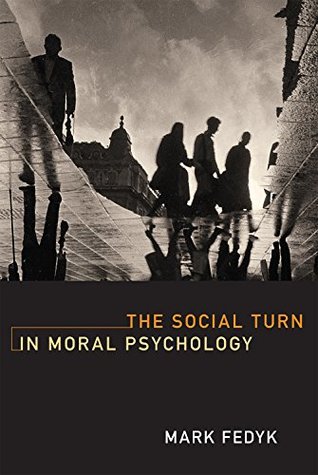
The social turn in moral psychology is a probing inquiry into the disconnect between moral philosophy and empirical approaches to ethics. Drawing on a refreshing range of examples—including student protest movements, racial oppression, education policy, and life expectancy outcomes—fedyk offers a promising strategy for bringing normative theory into alignment with the social sciences.
Feb 9, 2021 their focus is on one especially important type of moral progress: gains in inclusivity.
View student reviews, rankings, reputation for the online phd in psychology / social psychology from walden university study the ways in which social behavior affects nearly all of a person’s experiences in society with this doctoral social.
Longitudinal multilevel models of the big-fish-little-pond effect on academic self-concept: counterbalancing contrast and reflected-glory effects in hong kong schools.
In social psychology, attribution involves making inferences about the behaviors of others. Shereen lehman, ms, is a healthcare journalist and fact checker.
This comprehensive and cutting-edge volume maps out the terrain of moral psychology, a dynamic and evolving area of research.
Within conventional stage 3: societal norms stage 4: law and order.
In the 1960s, the social psychologist stanley milgram did a famous research study called the obedience study. It showed that people have a strong tendency to comply with authority figures. It showed that people have a strong tendency to comply with authority figures.
The individual now takes into consideration a larger perspective, that of societal laws. Moral decision making becomes more than consideration of close ties to others. The individual believes that rules and laws maintain social order that is worth preserving.
Cultures in which the needs of the group take precedence over the individual tend to regard morality strictly as a social phenomenon that takes into account the needs and expectations of group members. Being a moral human being in the collective sense requires protecting the image and welfare of others in the group.
Apr 1, 2015 we turn to moral psychology, and in particular to moral foundations theory, to analyze the essential reasons that make owners feel that they.
In a literature review, researchers combined findings from the fields of moral psychology and intergroup psychology to investigate the dynamics of outrage, which they define as anger at the violation of one’s own moral standards. “anger, if it is effectively communicated, can be leveraged into collective, social action”.
4 social psychology philosophers have begun to notice that recent social psychology challenges ordinary and philosophical views about character traits. Flanagan (1991) discusses the challenge at length, arguing that it is not as radical as it may seem.
Liane young is an associate professor of psychology at boston college, where she is the director of the morality lab, which specializes in moral psychology.
Social psychology is the scientific study of how people's thoughts, feelings, beliefs, intentions and goals are constructed within a social context by the actual or imagined interactions with others.
Moral transformation is explained as the embodiment of moral typecasting, the tendency to “typecast” good- and evildoers as more capable of agency and less sensitive to experience. Implications for power, aging, self-control, and recovery are discussed.
In the development of conscience, young children become more socially and emotionally competent in a manner that provides a foundation for later moral conduct (thompson, 2012). Social influences such as cultural norms impact children's interests, dress, style of speech and even life aspirations.
Benefiting from misfortune: when harmless actions are judged to be morally blameworthy personality and social psychology bulletin, 38(1), 52-62.
Psychologist lawrence kohlberg (1927–1987) extended upon the foundation that the new focus constitutes stage 5, the ethics of social contract. Will the assignment lose its educational value if the student has to turn it in prematu.
Moral psychology is a field of study in both philosophy and psychology. Historically, the term moral psychology was used relatively narrowly to refer to the study of moral development. Moral psychology eventually came to refer more broadly to various topics at the intersection of ethics, psychology, and philosophy of mind.
Moral psychology is a discipline of both intrinsic and practical interest; uncovering the determinants of moral judgment and behavior is fascinating in its own right, and a better understanding of these determinants may help us to better understand what educational and policy interventions may facilitate good conduct and ameliorate bad conduct.
The more subjects valued a social role, the greater the weight they gave to moral character traits in forming their impression of a person in that role.
He could be characterized as the forerunner of humanistic psychology. Adler's approach was a kind of holistic social field theory that predated lewin. For affection, then the child may turn in on himself or herself.
Oct 1, 2012 this illustration is part of a series of social science bites illustrations by scientific illustrator alex what can psychology tell us about morality?.
This last question, how far rawls's moral psychology has a social however, constructivism does not presuppose that this is the case, and it may turn out that.
With less than a week until america casts ballots in what has become one of the most controversial us presidential elections in history, ted invited the social psychologist and expert on the psychology of morality jonathan haidt to talk about our divisions — and how we might heal.
The early chapters aim to place some of the most common pitfalls of contemporary moral psychology into theoretical context. Fedyk takes issue, in particular, with the fervor for positing universal and innate moral-cognitive modules solely on the basis of speculations about what would have been adaptive for our ancestors.
The aim of education is the all round development of personality of a child. Such a child is, in turn, expected to take part in developing the society in which he is born. From the point of view of personality development, the most significant aspect of a child’s world is his social environment.
Request pdf the social turn in moral psychology in this book, mark fedyk offers a novel analysis of the relationship between moral psychology and allied fields in the social sciences.
This, in turn, requires us to understand interpersonal growth as both the means and end of human action.
Social emotional development represents a specific domain of child development. It is a gradual, integrative process through which children acquire the capacity to understand, experience, express, and manage emotions and to develop meaningful relationships with others.
In trying to understand moral behavior, researchers historically adopted a cognitive-rationalistic approach that emphasized reasoning and reflection.
A place where to post summaries of human nature papers (mostly from psychologists and economists).
Learn about social comparison theory, the process people go through in order to know themselves in comparison to other people. Emily is a fact checker, editor, and writer who has expertise in psychology content.
The influence of social variables and moral disengagement on prosocial and antisocial behaviours in field hockey and netball j sports sci� 2009 jun;27(8):843-54.
Socialization approaches have focused on the development of conscience through guilt and internalized behavior, typically measured in terms of compliance, whereas cognitive-developmental theories.
Moral psychology is the study of moral identity development, or how people integrate moral ideals with the development of their own character. Moral psychology differs from moral philosophy in that it studies how we make decisions, rather than exploring what moral decisions we should make. It encompasses the study of moral judgment, moral reasoning, moral character, and many related subjects at the intersection of philosophy and psychology.
Fedyk argues that moral psychology should take a social turn, investigating the psychological processes that motivate patterns of social behavior defined as ethical using normative information extracted from the social sciences.
Ted talk subtitles and transcript: psychologist jonathan haidt studies the five the world, and who hope to turn that understanding into a better future for us all? you are liberal, left of center -- on social issues, primari.
Video created by wesleyan university for the course social psychology. This week's goals are to: (1) learn how people explain their behavior and the behavior.
Both studies demonstrate that defensiveness increases in response to social/moral threat. Further, study 2 demonstrates that this defensiveness can be reduced by addressing the underlying threat to social/moral identity via value affirmation, encouraging moral engagement, and repair.
And how are these decisions influenced by psychological, social, and cultural forces? such questions form the foundation of the field of moral psychology. In trying to understand moral behavior, researchers historically adopted a cognitive-rationalistic approach that emphasized reasoning and reflection.
Ever notice how people behave differently in groups? learn how social psychology studies the way people think, behave, and feel in social environments.
Particular moral expressions or rules are enunciated and passed on as cultural inheritances and thus memes. The primatologist, frans de waal, was on of many who have argued that the roots of human morality lie in social animals such as the primates, including apes and monkeys.
Post Your Comments: