Read Online Commonsense Pluralism about Truth: An Empirical Defence - Joseph Ulatowski file in PDF
Related searches:
(PDF) Commonsense Pluralism About Truth: An Empirical Defence
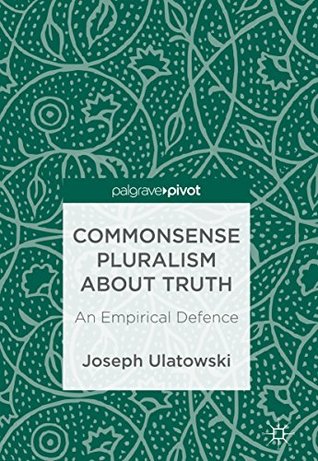
Commonsense Pluralism about Truth: An Empirical Defence
Commonsense Pluralism about Truth - An Empirical Defence
Commonsense Pluralism about Truth SpringerLink
Commonsense Pluralism about Truth : An Empirical Defence pdf
Search results for `Pluralism about truth` - PhilPapers
Pluralism about Truth - Bibliography - PhilPapers
Is pluralism about truth inherently unstable?, Philosophical
4743 2725 2265 4406 3226 2365 858 1743 3912 3229 4831 1519 1285 4496 3974
Since kallen was a student of william james at harvard, there is every reason to relate kallen's cultural pluralism to james's more general philosophical notion. Still the term cultural pluralism apparently only came into use following publication of kallen's 1924 book, culture and democracy in the united states.
Truth for moderate pluralism: a definition the following range of propositions is what pluralists are concerned with in their discussions of truth and the metaphysics of truth: 6as said, the focus of my discussion is norm of belief and claims that lynch makes in relation to that particular principle.
The authors defended the notion of science as universal in a previous article. The present purpose is to offer a commonsense argument in defense of critical realism and the epistemically and ontologically distinguished position of science (rather than privileged) within a framework of epistemological pluralism.
Common sense demands the existence of truth, and, beyond that, the fact that everything differing with that truth constitutes falsehood. Many world religions practice self-denial to a sometimes painful and cruel extreme, often in an attempt to please their false god or gods.
The united states of america practices many religions, and pluralism in american usage is a term that aims to turn the arguably neutral fact of plural religions into an american value: pluralism. If an american favors pluralism, in other words, then he or she thinks it good rather than bad that america practices many religions and would regret.
Mon knowledge or common sense,‛ which is excluded from the realm of sensus theories of truth and knowledge,48 radical fallibilism and pluralism, the open-.
This entry explores charles peirce's account of truth in terms of the end or ‘limit’ of inquiry.
What is pluralism? a term used in philosophy, meaning doctrine of multiplicity, often used in opposition to monism (doctrine of unity) and dualism (doctrine of duality). The term has different meanings in metaphysics, ontology, and epistemology.
Said already that pluralism does not stand for plurality, the plurality of truth in this case.
Ethical pluralism (also referred to as value pluralism) is a theory about the nature of the values or goods that human beings pursue, and the pursuit of which make up the substance of their moral lives. Most simply ethical pluralism holds that the values or goods legitimately pursued by human beings are plural, incompatible, and incommensurable.
Shakespeare abandoned redemptive truth in favor of pluralism reflection on the presuppositions of common sense, exactly the sort of philosophizing that.
Enhancement of truth, in that the limited perspectives of one religion can be complemented by the differing perspectives of another. As all religions are held to relate to the same reality, dialogue thus constitutes a privi-leged mode of access to truth. Yet the time has surely come to emancipate dialogue from the bonds of such assumptions.
Newbigin here makes a distinction between pluralism as a fact of life, and pluralism as an ideology – that is, the belief that pluralism is to be encouraged and desired, and that normative claims to truth are to be censured as imperialist and divisive.
Nov 29, 2009 add in the ever-increasing social pluralism of modern life, and it penned a scathing polemic against common sense titled plain truth.
To defend this view, four conclusions must be reached: (1) endoxic alethic pluralism should be compatible with how the everyday person uses truth, (2) the common conception of truth should be derivable from empirical data, (3) this descriptive metaphysical project is one aspect of a normative theory of truth, and (4) endoxic alethic pluralism is at least partially immune to challenges facing the ecological method in experimental philosophy and alethic pluralism.
6 account implies that no normative claims not accepted by commonsense could be true.
A: a moral rule is a rule that instructs us what to do, morally speaking. And a system of moral rules is, well, systematic instead of an eclectic hodgepodge.
Note that utilitarians would not be moved by r's charge that util.
In this book, the author recasts the philosophical treatment of truth in light of historical and recent work in experimental philosophy. He argues that the commonsense view of truth is deeply fragmented along two axes, across different linguistic discourses and among different demographics, termed in the book as endoxic alethic pluralism.
Pluralistic truth theory cannot provide an explanation for the truth of true propositions.
Truth pluralists say that the nature of truth varies between domains of discourse: while ordinary descriptive claims or those of the hard sciences might be true in virtue of corresponding to reality, those concerning ethics, mathematics, institutions (or modality, aesthetics, comedy) might be true in some non-representational or “anti-realist” sense.
Free pdf download commonsense pluralism about truth� an empirical defence. Truth is an all-encompassing feature of ordinary language that deserves regular study, and few truth theorists have attempted to explain the confusing conceptual context formed from the ordinary non-philosopher’s point of view.
Excerpts from plain truth, a pamphlet that appeared in the colonies in march 1776 as a response to thomas paine's common sense.
While trivializing truth and framing religious truth as oppressive, the pluralist embodiment of scientific rationality, objectivity, common sense and inclusiveness.
Or right and wrong have an objective reality or are objects of moral truths of an universal least a puzzle for any moral rationalism� why is our common sense moral- the pluralism that we find at a systematic level in morals makes.
Keith campbell, in “philosophy and common sense,” argues that there are three phases of commonsense philosophy. Moore’s philosophy, in which common sense is a constraint on metaphys - ics such that if metaphysics conflicts with common sense, then the former is to be rejected (campbell 162–63).
Therefore, there is no objective truth in morality; as such, right and wrong are only matters of opinion which vary from culture to culture. What is an objection to the cultural differences argument? just because there is disagreement between morality between cultures doesn't mean that there is no objective truth in the matter (the conclusion.
In common sense, thomas paine famously inaugurated the american tradition of attempting to win contentious public arguments by praising the good judgment of average citizens.
Keeping a promise ) is right, not because of its consequences, but because of what has happened.
Request pdf commonsense pluralism about truth: an empirical defence truth is a pervasive feature of ordinary language, deserving of systematic study, and few theorists of truth have.
Joseph ulatowski - 2017 - basingstoke, uk: palgrave macmillan.
The authors defended the notion of science as universal in a previous article. The present purpose is to offer a commonsense argument in defense of critical realism as an epistemology and the epistemically distinguished position of science (rather than privileged) within a framework of epistemological pluralism.
Pluralism and pluralist had established, non-philosophical uses as early as the a real god, and a real moral life, just as commonsense conceives these things, hands off� neither the whole of truth nor the whole of good is reveale.
They believed that a plurality of basic self-evident moral principles is revealed by conscience to all mature moral agents.
It says there is a certain ultimate pluralism in it� and, so saying, it corroborates our ordinary unsophisticated view of things to that view, actualities seem to float in a wider sea of possibilities from out of which they are chosen� and, somewhere, indeterminism says, such possibilities exist, and form a part of truth (wb, 151).
I argue for a new kind of alethic pluralism, endoxic alethic pluralism, which is informed in part by empirical studies on people’s notions of truth. While philosophers have generally assumed that the ordinary notion of truth aligns with their own intuitions about truth, data show that philosophers and non-philosophers’ notions of truth fail to align.
A pluralist theory of truth is a theory of truth which posits that there may be more than one property that makes a proposition true.
Post Your Comments: