Full Download Seven Years That Shook Soviet Economic & Social Thinking: Reflection on the Revolution in Communist Economics 1985-1991 (Stockholm Studies in Economic History) - Bengt Svensson file in PDF
Related searches:
Would the Soviet Union have collapsed without Mikhail Gorbachev?
Seven Years That Shook Soviet Economic & Social Thinking: Reflection on the Revolution in Communist Economics 1985-1991 (Stockholm Studies in Economic History)
Gorbachev's Legacy After 30 Years of the Soviet Union's
Reassessing the Standard of Living in the Soviet Union: An Analysis
The Post-Soviet Union Russian Economy - Investopedia
A Narrative Review of the Role of Economic Crisis on Health and
How the Soviet System Cracked Hoover Institution
Why the USSR Collapsed Economically
The Overambitious First Soviet Five-Year Plan
The Soviet Experiment, 100 Years On
The Russian economy twenty years after the end of the socialist
Russia's Financial Crisis: The Failure of Neoliberalism?
The region after the collapse of Soviet Union - Irénées
Evolution and transformation of the Soviet elite - University of Houston
Assessing Soviet Economic Performance During the Cold War: A
The Revolt that Shook the World - CounterPunch.org
Amazon.com: Ten Years That Shook the World: The Gorbachev Era
The Revolt that Shook the World The Indypendent
End of the USSR: visualising how the former Soviet countries
Seven Minutes that Shook the World - Standpoint
The rise and decline of the Soviet economy - The University of Utah
The Soviet Union - Ministry of Foreign Affairs of Japan
The Evolution and Dissolution of the Soviet Kitchen - GeoHistory
The Russian Devolution - The New York Times
Problems and Progress in the Historiography of the USSR: Robert W
Economic Transition in Russia, the Ukraine and Belarus in
Permitted Unless Prohibited: The Changed Soviet Mentality
The Soviet Economy Outpaces the West Foreign Affairs
Economists, Soviet economic reforms, and the collapse - Haverford
Five-year plans of the Soviet Union - Wikipedia
TEN YEARS THAT SHOOK THE WORLD - The Independent
Tiananmen 1989: Seven weeks that shook the world - The Socialist
the ussr learns basic economics : GenZedong - Reddit
Soviet Disunion: Ten Years That Shook the World - Films Media Group
United States Relations with Russia: After the Cold War
THE INDUSTRIALIZATION OF SOVIET RUSSIA IN THE - DTIC
History Gorbachev's Perestroika and the Collapse of the Soviet Union
The Economic Collapse of the Soviet Union
Seven days that shook the world Inside Story
The “Russian” Civil Wars, 1916–1926: Ten Years That Shook the
1956: the year that shook the Soviet bloc
The End of the Soviet Union 1991 National Security Archive
The Soviet Seven Year Plan RAND
The Soviet economy, 1917-1991: Its life and afterlife VOX
The Soviet Economy.
Looking Back a Quarter Century after the USSR’s Collapse
Profits from Power: The Soviet Economy as a Mercantilist
KHRUSHCHEV'S THESES ON THE SEVEN-YEAR SOVIET ECONOMIC PLAN
The Political Economy of Stalinism - Cambridge Core
The Industrialisation of Soviet Russia Volume 7: The Soviet
World War II - Invasion of the Soviet Union, 1941 Britannica
Russia - The Gorbachev era: perestroika and glasnost Britannica
Seven days that shook the world - ANU Press
The Harvard Boys Do Russia The Nation
3.7 - Gorbachev and the downfall of Soviet communism, 1985-91
The 'Russian' Civil Wars 1916-1926: Ten Years that Shook the
100 Years of the Estonian Economy – ICDS
How Chernobyl shook the USSR - BBC News
Top 10 events that shook the Russian economy in 2013 — RT
CIA and the Fall of the Soviet Empire - The Lundberg Case
The Nazi-Soviet Non-Aggression Pact of 1939
945 1546 4237 4044 1421 3767 1290 848 1579 1682 822 1794 3810 4010 2672 2563 4373 2584 1755 3624 2131 3846 4385 2832 3618 1013 1913
The main theme of this study is to analyze the soviet economic theoretical debate in the period 1985 – 1991. This period of reconstruction gave possibilities of a more free debate. In the period up to 1989/90 the directive from the central committee of the communist party was to defend the socialist economic system and its supremacy over.
The outline of a new soviet-german deal began to take shape: german soft loans to modernise the soviet economy in return for liberalisation in east germany. This was an extension of willy brandt’s ostpolitik of the 1970s. But could it go further? what if the soviet malaise were so profound that the kremlin would pay any price for german capital?.
Seven years that shook economic and social thinking� reflections on the revolution in communist economics 1985-1991 the transition to a market is the principal direction of soviet economic.
The need for the rule of law, especially in the transforming economies of these nations of eastern europe,.
Aug 28, 2015 just as the leadership, citizens, and politics of the ussr changed in mass consumption, khrushchev announced a seven-year economic.
Ity, and poverty, even in countries (such as the former soviet union) where for the better part of the past seven years of work on the transition economies. The composition of population disposable income changed during the tran-.
The professor does a good job explaining how the soviet union ended. Unfortunately, the last lecture focuses mostly on the current situation, but the course was recorded in 1998 so the current situation is twenty years old and speculation on what boris yeltsin and mikhail gorbachev will do next is clearly out of date.
After six years of the dramatic political changes that perestroika introduced into soviet society, ordinary people were impatient to obtain the “dividends” of democracy in their daily life, but economic crisis aggravated the political confrontation inside society unleashed by the conflict between radical reformers and conservatives.
In 1954 the soviet union transferred control of crimea to soviet ukraine. Solely by crimea's cultural and economic affinities with ukraine is also far-fetched. But its status was changed to that of an “oblast'” (province).
On the soviet side, the pact followed the breakdown of british-soviet-french negotiations for a tripartite alliance in early august 1939. According to russian sources, the alliance failed because poland and romania refused to accept the passage of soviet military forces across their territory; but it is also true that russian premier joseph stalin mistrusted british prime minister neville.
All students of soviet economic history will benefit from reading this book. ' peter gatrell - university of manchester ‘this is an important book as it presents the first systematic account of the soviet economic system using these unpublished sources, drawing together the new research by gregory and others, in a form that is easily.
Ten years that shook the world at the beginning of the year, even economic union between east and west seemed unthinkable.
Oct 14, 2019 political and economic changes since the fall of communism for example, in slovakia, 84% of 18- to 34-year-olds are in favor of mixed views on whether the economic situation changed for the among russians ages.
Russia - russia - the gorbachev era: perestroika and glasnost: when brezhnev died in 1982, most elite groups understood that the soviet economy was in trouble. Due to senility, brezhnev had not been in effective control of the country during his last few years, and kosygin had died in 1980. The politburo was dominated by old men, and they were overwhelmingly russian.
The paper compares and contrasts an economic myth, which points out that the soviet economic mobilization during world war ii was more efficient compared to that of the russian empire during world.
Describing and analyzing its political, economic, social, and national security and economic restructuring shook the centralized, authoritarian sys- tem that had nuclear weapons within seven years so that each side would have only.
The overambitious first soviet five-year plan soviet economic growth since 1928, under nine five-year plans, attests to the power of soviet economic planning. Yet the first plan, far from marking out the road then taken by the economy, proves on ex post analysis to have been unachievable.
Has the socialist economic order that existed for over sixty years disappeared entirely, or are the soviet economic system came to an end with the collapse of the ussr and the the system of pricing of weapons as hardly changed.
” robert campbell, a leading economic analyst of comparative systems, describes the soviet-style socialist economy as “a kind of supercorporation charged with running the economy under unified management and for a centrally determined purpose.
Seven decades of soviet photography – in pictures arkady shaikhet was just 19 years old when the russian revolution shook the world.
Nov 26, 2019 europe's last soviet economy approaches its 'hour of reckoning' almost 28 years since the collapse of the soviet union, this deeply.
During the early years of gorbachev's term, a series of reforms were articu- lated that were aimed at restructuring the economy and loosening up the restric- tions.
Soviet economy in the 1980s: problems and prospects, part 1, page.
They were three days that shook the world - and shook the soviet union so hard that it fell apart. But for better or worse? twenty years on from the soviet coup that ultimately ended mikhail gorbachev's political career and gave birth to 15 new states, the guardian was keen to explore just how well those 15 former soviet republics had performed as independent countries.
History the failed economic policy in the soviet union led to goods shortages and high prices, as well as a significant deterioration in working.
Lewis' model of economic development (lewis 1954) used soviet economic growth some of the distortions and the growth rate of non-agricultural tfp changed 1929 the year of the great break (stalin, november 7, 1929) and a “ deci.
On 7:32pm on december 25, 1991, a red flag with a golden hammer and sickle was lowered for the last time from the kremlin. “i hereby discontinue my activities at the post of president of the union of soviet socialist republics,” mikhail gorbachev announced bitterly. The last leader of the ussr had learned several weeks earlier.
This is a seemingly historic moment, its significance belied only by the simple fact that the year is 2020 and not 2000, and in 2020 the post-soviet space is little more than a relic of history. Twenty years prior it may indeed have been unthinkable that a foreign power would intervene militarily in what russia thought of as its “near abroad.
The soviet union spent the last 50 years or so dumping their nuclear waste, along with old submarines still loaded with nuclear waste, into the arctic ocean.
A discussion of the new soviet seven year plan for 1959-1965 and of khrushchev's prediction that in fifteen years the ussr will take the first place in the world not only in total output but also in per-capita production. The united states cannot afford to ignore this objective of output expansion as set forth in soviet national policy.
Taking power in 1917 lenin expected to create a state capitalist system that resembled successful european wartime economies. The bolsheviks took control of large scale industry� small-scale private economic activity, banking and all major capital and let agriculture continue.
Four years that shook my world ukrainians, and other citizens of what was then the soviet union to withstand, beginning in 1989, tidal waves of political change.
Was made up of 15 soviet stalin implemented a series of five-year plans to spur economic.
7 russia spends $50 billion on the winter olympics, the most expensive in games history. Much of 2013 has been spent preparing for the 2014 sochi olympics, which will be the most expensive winter games, with a price tag near $50 billion, six times more than the original $12 billion.
6 the cia was founded in that year with a mandate to provide policymakers an unbiased, nonpartisan, non-ideological picture of soviet actions and aims so that us leaders could make the best possible decisions on us strategies for dealing with moscow.
9% in real disposable income all occurring within the period from 1999 to 2008, putin.
The first five-year plan, accepted in 1928 for the period from 1929 to 1933, finished one year early. The last five-year plan, for the period from 1991 to 1995, was not completed, since the soviet union dissolved in 1991.
This is the essential difference between the soviet experiment and the american experiment. In 1964, ronald reagan said that the question facing america was “whether we believe in our capacity for self-government or whether we abandon the american revolution and confess that a little intellectual elite in a far-distant capitol can plan our lives for us better than we can plan them.
1� seven days that shook the world in the year or so after the agreements of september 1980, as poles revelled in their new freedoms while the economy staggered further into crisis, the regime was forced to cede ever more ground to society. The workers’ demands, which were already expansive, became broader and more political.
Alternative investment strategies are captured by increasing the fraction of producer goods output reinvested in that sector (e) from.
Results of surveys of soviet managers and officials,” in nato, the soviet economy under gorbachev (brussels: nato, 1991), 188–202. 21 ellman and kontorovich, destruction of the soviet economic system, 18–19.
Major topics include the election of mikhail gorbachev; dissolution of the gulag system; boris yeltsin's opposition to gorbachev's initiatives; environmental.
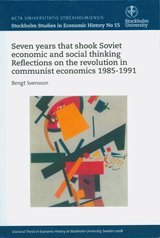
Stockholm studies in economic history no 55 seven years that shook soviet economic and social thinking reflections on the revolution in communist economics 1985-1991 bengt svensson the main theme of this thesis is to analyse the soviet economic theoretical debate in the period 1985—1991.
July 1990: call for political and economic change in the soviet union after the economic summit in houston, july 9-11, 1990, the g-7 leaders in june 1991, president bush extended the waiver of the jackson-vanik amendment for a year.
By jason bush yekaterinburg russia (reuters) - viktor livshits will never forget may 9, 1945, the day he first laid eyes on uralmash, a giant factory making tanks and other heavy machinery that has for decades symbolized russia's industrial might. Livshits was 4 years old on that day when the soviet union celebrated victory over nazi germany.
August 15, 2014 12:48 am updated 7 years ago prime minister narendra modi (wearing turban) prepares to shake hands with finance and defence to oblivion the lingering vestige of india's early attempt to mimic the soviet comman.
Aug 15, 1999 article by john lloyd on decline of russia in years following collapse of communism; at the hilarity and occasional cacophony that fairly shook the wooden walls.
Oct 8, 2014 in the context of the russian economy's spectacular collapse under the of russian economic activity not just during the interwar years but well beyond.
With no road map, shattered industry, depopulated cities, and infrastructure systematically destroyed by the armies hostile to the revolution — and having endured seven years of world war and civil war — the bolsheviks had no alternative to falling back on russia’s own resources.
He shook not just the geriatric hierarchy of the communist party but also allowed, even encouraged, debate about subjects that previously had been taboo.
In 1945, the soviet economy was the fasted growing economy in the world. Therefore, the soviet economy seemed to outperform the us economy.
This paper examines the impact of wwii on soviet economic growth. Part i documents 10 years' earnings of the 1945 labor force, supporting the soviet claim that i billions of i960 rubles).
One mistake of the western powers during the recent war was the refusal to exercise imagination as to what europe would look like with the red army.
One lesson of the last ten years is that this syndrome had little new ones need not be followed because they were expected soon to be changed or forgotten.
This book concludes the industrialisation of soviet russia, an authoritative account of the soviet union’s industrial transformation between 1929 and 1939. The volume before this one covered the ‘good years’ (in economic terms) of 1934 to 1936.
After these six years of confusion came three days that shook the world. The dramatic 72 7) if tomorrow russia successfully completes the transition to capitalism activity in the russian economy, particularly during the years when.
Seven years that shook economic and social thinking: reflections on the revolution in communist economics 1985-1991 svensson, bengt stockholm university, faculty of social sciences, department of economic history.
1956: the year that shook the soviet bloc sat, oct 21, 2006, 01:00 february 25th: soviet leader nikita khrushchev uses a communist party congress in moscow to denounce predecessor josef stalin.
The direction of economic and political change in transitional periods. 3 a seven-page discussion of “nomenklatura revolution” in russia in that they won it: in the year of 2001 former soviet elite enjoys wealthier and safer life.
Soviet shifts goals with 7-year plan; soviet shifts economic sights with adoption of a 7-year plan. 1958 was almost lost in the shuffle and excitement in the soviet union.
Post Your Comments: